About Starred Up
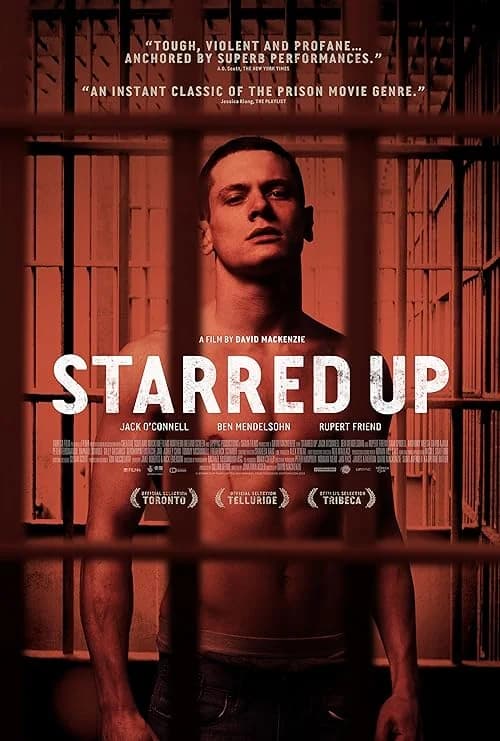
Starred Up (2013) is a raw and unflinching British prison drama that immediately establishes itself as one of the most authentic depictions of incarceration ever put to film. Directed by David Mackenzie with visceral intensity, the film follows 19-year-old Eric Love (Jack O'Connell in a career-defining performance), a violently troubled youth 'starred up'—transferred prematurely—to an adult prison. From his first moments, Eric's explosive temper puts him in constant conflict with both inmates and corrupt guards, setting the stage for a harrowing examination of institutional failure and fractured family bonds.
The film's power derives from its remarkable performances and unvarnished realism. Jack O'Connell delivers a physically and emotionally demanding portrayal of Eric, capturing both his terrifying capacity for violence and his vulnerable, damaged core. Ben Mendelsohn is equally compelling as Neville, Eric's long-incarcerated father who attempts to reconnect with his son while navigating his own compromised position within the prison hierarchy. Their strained, painful relationship forms the emotional heart of the film, exploring how cycles of violence and abandonment perpetuate across generations.
David Mackenzie's direction is taut and immersive, using handheld camerawork and claustrophobic framing to create an atmosphere of constant tension. The screenplay by Jonathan Asser—drawing from his own experiences as a prison therapist—avoids easy moralizing, instead presenting a complex portrait of a system that often exacerbates rather than rehabilitates. The therapeutic sessions led by Oliver (Rupert Friend) offer glimmers of hope amidst the brutality, suggesting that change is possible but extraordinarily difficult.
Viewers should watch Starred Up for its uncompromising honesty, powerhouse performances, and thought-provoking exploration of masculinity, violence, and redemption. It's not an easy viewing experience—the violence is graphic and the language harsh—but it's a profoundly impactful one that stays with you long after the credits roll. For fans of gritty social realism and character-driven drama, this film represents British cinema at its most powerful and urgent.
The film's power derives from its remarkable performances and unvarnished realism. Jack O'Connell delivers a physically and emotionally demanding portrayal of Eric, capturing both his terrifying capacity for violence and his vulnerable, damaged core. Ben Mendelsohn is equally compelling as Neville, Eric's long-incarcerated father who attempts to reconnect with his son while navigating his own compromised position within the prison hierarchy. Their strained, painful relationship forms the emotional heart of the film, exploring how cycles of violence and abandonment perpetuate across generations.
David Mackenzie's direction is taut and immersive, using handheld camerawork and claustrophobic framing to create an atmosphere of constant tension. The screenplay by Jonathan Asser—drawing from his own experiences as a prison therapist—avoids easy moralizing, instead presenting a complex portrait of a system that often exacerbates rather than rehabilitates. The therapeutic sessions led by Oliver (Rupert Friend) offer glimmers of hope amidst the brutality, suggesting that change is possible but extraordinarily difficult.
Viewers should watch Starred Up for its uncompromising honesty, powerhouse performances, and thought-provoking exploration of masculinity, violence, and redemption. It's not an easy viewing experience—the violence is graphic and the language harsh—but it's a profoundly impactful one that stays with you long after the credits roll. For fans of gritty social realism and character-driven drama, this film represents British cinema at its most powerful and urgent.